
Research and Educational Institutions
The Tsukuba Science City was constructed as a national project aimed at alleviating Tokyo's overcrowding through the planned relocation of national research and testing institutions, while also establishing a hub for high-level research and education.National research and educational institutions previously located in Tokyo were systematically relocated or newly established in Tsukuba. Concurrently, urban infrastructure development progressed, and private companies expanded their presence. Leveraging the concentration of research institutions, the city steadily built its reputation as a world-class science and technology hub, producing Nobel laureates among its achievements. Today, it stands as Japan's largest science city, home to approximately 20,000 researchers.
Japan promotes international brain circulation to generate outstanding research outcomes. To enhance global knowledge exchange and strengthen research and innovation capabilities, Japan aims to further internationalize its research environment, promote international talent exchange, and firmly integrate itself into the global brain circulation network. Strengthening international brain circulation is essential for dynamic research and development, and the Tsukuba Science City is expected by many countries and regions to play a key role in this endeavor.Furthermore, the Tsukuba Science City hosts a large number of corporate research and development institutions. Many of these corporate R&D facilities possess large-scale experimental equipment and laboratory facilities to develop new products utilizing advanced knowledge and technology, and they also conduct joint research with national research and development institutions. Additionally, external users can access world-class large-scale experimental facilities such as KEK's Photon Factory and NIMS's high magnetic field equipment.
Major Research Institutions Located in Tsukuba
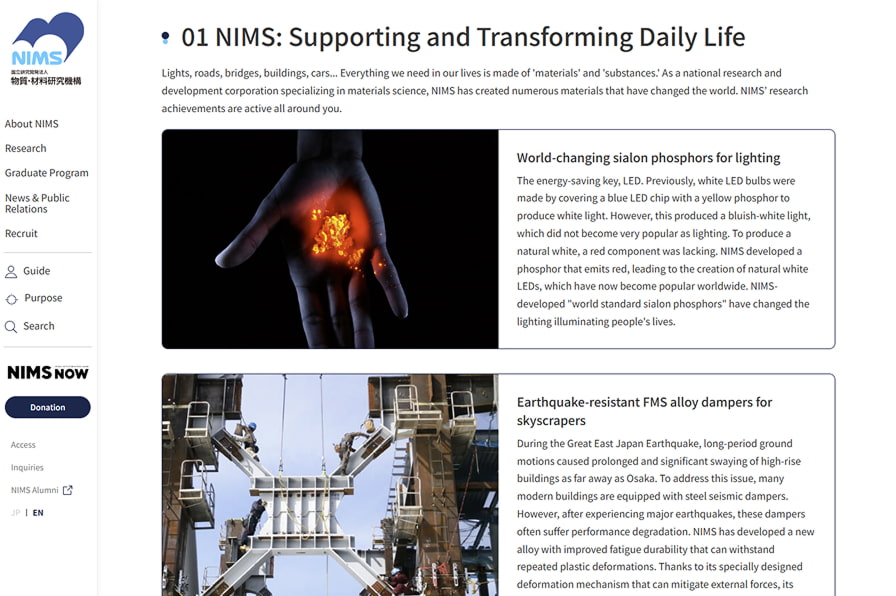
National Institute for Materials Science (NIMS)
NIMS is Japan’s national research and development agency dedicated to advancing materials science.
From energy and the environment to healthcare, infrastructure, and mobility — every technology that supports our daily lives is built upon materials and substances.
At NIMS, we pursue not only fundamental and basic research, but also work to translate scientific discoveries into practical applications that benefit society.
The progress of humankind has always evolved hand in hand with advances in materials science. Today, as the world faces pressing environmental and resource challenges, the role of materials research has become more crucial than ever.
Driven by our vision — “Changing the world with materials” — NIMS continues to conduct world-leading research to build a sustainable and prosperous future for all.
University of Tsukuba
The University of Tsukuba was established as an “open university” following the relocation of Tokyo University of Education to the Tsukuba Science City. It is not only a literal “open university” without gates or fences, but also functions as a truly open institution in its internal organizational management. Barriers between departments at the University of Tsukuba are significantly lower compared to other universities. Its faculty organization structure also facilitates collaborative research. Instead of the traditional “department system” with large numbers of faculty, it employs a “group system” with smaller teams. This structure makes it easier for faculty and researchers to freely pursue joint research. Collaboration between fields like medicine, biology, and engineering has advanced, fostering significant growth in interdisciplinary research.
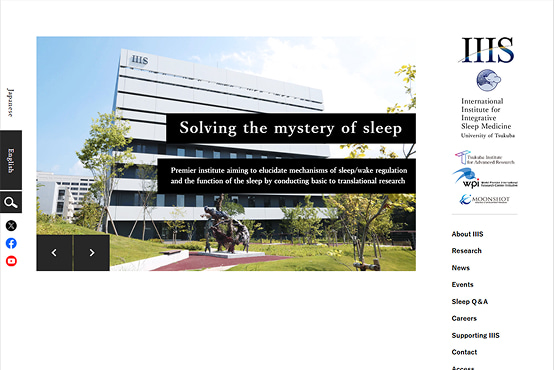
The University of Tsukuba hosts the International Brain Circulation IIIS (International Institute for Integrative Sleep Medicine), established as a world-leading research hub aiming to elucidate sleep-wake mechanisms and establish treatment strategies for sleep disorders. It positions international brain circulation as a key strategy for strengthening its activities. The institute aims to elucidate the mechanisms of sleep and hibernation and develop methods for the prevention, diagnosis, and treatment of sleep disorders. It features an open lab organizational structure incorporating the strengths of the American “department” system, characterized by a free environment where outstanding researchers can thrive regardless of age or career stage. It promotes research in “sleep medicine science,” integrating neuroscience, medicinal chemistry, and experimental medicine, aiming to contribute to human health advancement. By inviting researchers from overseas and creating a platform for domestic and international researchers to collaborate across borders, it drives cutting-edge sleep medicine science research.
National Institute of Advanced Industrial Science and Technology
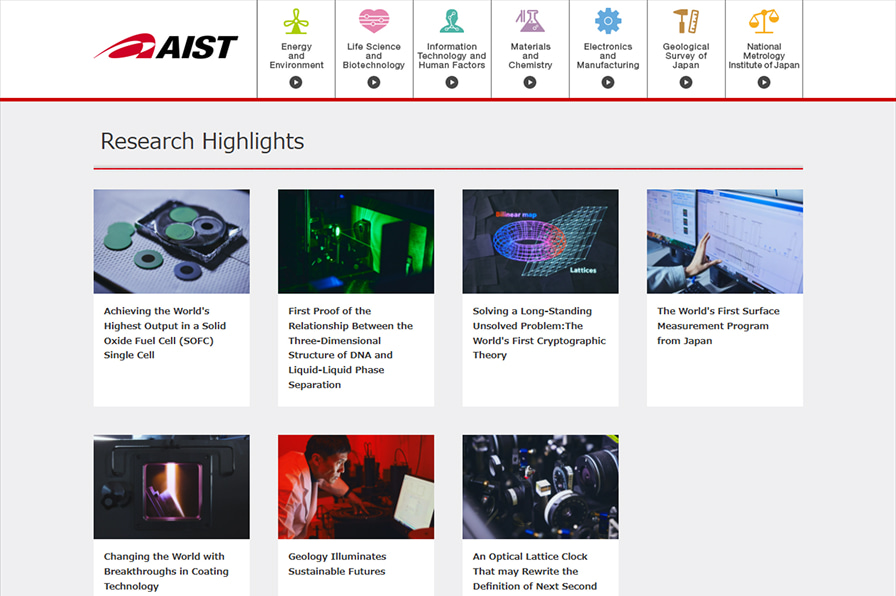
AIST (National Institute of Advanced Industrial Science and Technology) is one of the largest public research institutions in Japan.
Its mission is to solve social problems, and to strengthen Japan's industrial competitiveness.
AIST’s key strengths are a broad range of research capabilities at 12 research bases across the country, and social implementation of the technology through its subsidiary, AIST Solutions Co.
With our vision, “Create the Future, Collaborate Together”, AIST supports economic and social development through our collective research and development capabilities.
High Energy Accelerator Research Organization
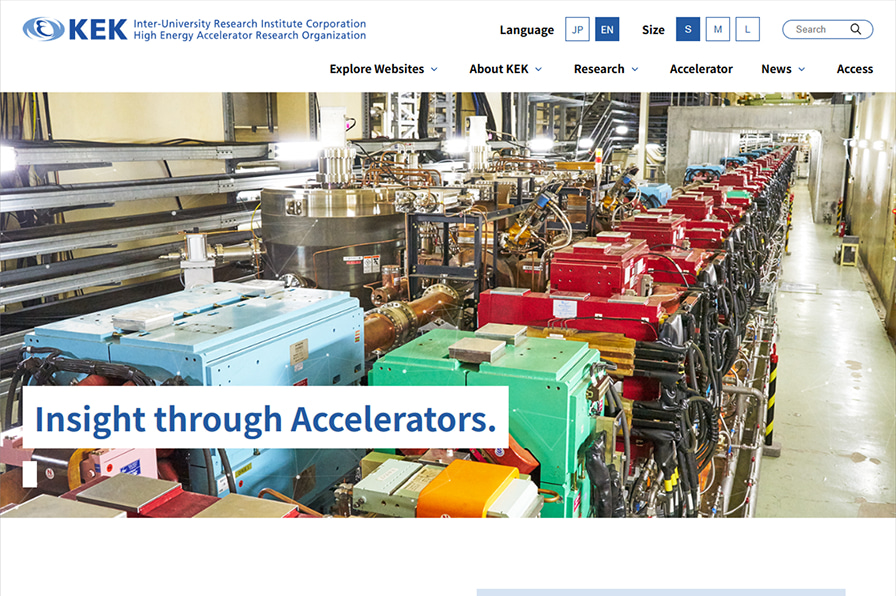
A “Inter-University Research Institute Corporation” conducting fundamental scientific research using accelerators. To explore the laws of nature and the fundamental structure of matter, it provides large accelerators and other research facilities to researchers worldwide, advancing cutting-edge research in particle and nuclear physics, material structure science, the fundamental structure of matter, and accelerator science. As an Inter-University Research Institute Corporation, it provides shared access to research facilities while conducting world-leading research activities in both theoretical and experimental fields, and places strong emphasis on human resource development.
National Institute for Environmental Studies
The National Institute for Environmental Studies (NIES) has been Japan's core research institute in environmental science since its establishment in 1974, undertaking interdisciplinary and comprehensive research across a wide range of environmental fields. NIES aims to advance scientific understanding of environmental conservation and promote the dissemination of knowledge on environmental preservation by conducting surveys and research related to global environmental conservation, pollution prevention, natural environment protection and improvement, and other environmental conservation matters. They also contribute to the government and society by providing scientific insights for environmental policy.